
Nonfiction
A Deep Dive into Audiobook Genres and Narration Approach

INTRODUCTION
I’ve been diving into different genres and the unspoken expectations for the writers and audiobook performers of these pieces. (See my list of articles HERE to find those articles.)
Today I want to talk about one of my favorite genres to perform:
NONFICTION
Nonfiction is Not Fiction which means it’s true. I’m not sure why they don’t just call it True Books, but nonfiction does sound smarter.
Not all nonfiction is the same.
Double negatives confuse me, so let me try to re-phrase that.
Each nonfiction title is unique. How you perform it depends on the sub-genre, but also on your gut instinct. The hardest part for me in nonfiction is deciding on the tone. (We’ll get to that in a minute.)
There are plenty of readers and listeners out there who looooooove nonfiction. They like learning things, they appreciate history, and they have a deep love for interesting true stories.
The writing can be philosophical, professorial, or warm and approachable. There can be deep emotions or no emotion at all. There can be a wild cast of characters or no characters. Famous people may appear (and disappear). There may be complicated language, thoughts, formulas, etc.
You never know what you’re going to get, exactly, with a nonfiction title. (I just finished recording a 15-hour title on the lore of Bigfoot and loved every second of it.)
Understanding the sub-genres of this type of book can help you ‘crack the nut’ on how to perform it.
More than any other genre, nonfiction requires deep research.
TONE
The tone of literary fiction is unique to each book. The tone you choose should fit the sub-genre. Here are some sub-genres:
Memoir
Biography
Autobiography
Business
Self-help
Historical
True Crime/Investigative
Educational
Travel writing
Cookbooks, art/music, etc. etc.
What tone you use depends on who the writer is, the subject matter, how it’s told, and the intended listener.
Examples:
Memoir/Autobiography:
I tend to use a more relaxed tone with this. I’m telling my important story to a friend, so I want to create intimacy in the listening. Most memoir I treat like fiction, as if it’s a one-person monologue. I will use character voices if it feels like it will help bring the book to life, or if it feels like it’s written more like fiction. If it’s an autobiography, the tone is usually a little more formal, not quite as intimate, maybe a little pulled back emotionally. You’re telling your story not to a close friend, but a colleague.
Historical, Educational, Biography:
For these texts, the listener is there to learn, so I’ll lean into a professorial vibe. I’m excited and engaged with the material and firmly rooted that what I’m sharing is important and fact. There is more distance with this type of read because you’re playing the role of a teacher. It can be a lovely experience to follow the text, differentiate the quotes, and explore the subject matter with subtle inflections and pacing.
Other non-fiction:
I really take a close look at what the subject is and who the listener might be. For a book I narrated on Jeff Buckley for Spotify, I thought of myself as a music critic and leaned into that. For health books, I’m excited to share information that’s possibly transformative. For parenting books, I’m warm and approachable, empathetic and encouraging. For True Crime, I lean into the mystery/thriller kind of read or pretend I’m a journalist uncovering clues. For business titles, I’m strong and pragmatic, but also excited.
Tone really depends on the book itself. Look at how the book is written, how quotes are used, and the type of language to help you decide on an approach.
CHARACTERS
You must decide how to voice your characters here. If it’s a piece that is written like a novel, you may choose to differentiate your characters the way you would if it were fiction. Some people say do not use character voices ever in nonfiction narration, but I’m not a fan of absolutes. I think it really depends on the book.
If it is a historical, biographical, or educational text, you may decide not to create characters but simply adjust the pitch of your voice when reading to indicate a quote or a different speaker.
PACING
Slow down. Imagine a class is taking notes. Make sure there’s time for the listener to synthesize the material.
Feel free to vary your pacing. Nonfiction isn’t slow and boring. (It shouldn’t be anyway.) Nonfiction is alive and vibrant, just like any good story.
Keep a sense of discovery as you narrate the text. There are fascinating stories on each page.
WHO IS CAST
This genre has a wide range of who is cast, but who is cast varies widely by sub-genre. Most historical texts are read by men, especially war books. (I love narrating these titles, but many of them are written for men and by men, so it’s rare for a woman to get them.)
Many (but not all) self-help books are written by and for women, so many of these titles are cast with women.
Biographies are usually read by the same gender of whomever the biography is about.
Still, there’s a wide variety of subjects, and a wide variety of who can read these books. I encourage casting to try and offer both male and female narrators to publishers and authors when casting a nonfiction title. When I was casting, I always included a variety of narrators in age/gender unless a certain type of person was specifically requested.
Sometimes, the perfect narrator for a nonfiction title isn’t who you expect it to be. The perfect narrator really depends on who engages with the material and is able to perform it in a way the draws the reader in and brings the book to life.
TO DO AND NOT TO DO
Approach this genre as you would any piece of writing: take it seriously and honor it.
Do create characters that honor and follow the text. (Don’t add in accents unless an accent is mentioned or it seems evident.)
Do choose a neutral tone for quotes, especially in historical texts. (Don’t impersonate famous people, even if you can. It takes the listener out of the text.)
When quoting, do add in a micro-pause before and after the quote. (Don’t say “quote unquote.)
Do skip endnotes, footnotes, publication references, lengthy URLs, and the bibliography, unless your producer tells you to read them. (Don’t read graphs or pictures either.)
Do ask your producer if you should read the piece word-for-word or make it ‘audio friendly’, for example by changing words like ‘reader’ to ‘listener’. (Don’t just change the script. You need permission to do that.)
Do take your time. (Don’t rush it. Sometimes slowing down can really make the book breathe and come to life.)
Do research pronunciation of names and places (Don’t just wing it. These are real people and their names are important.)
Do choose a character for yourself as the narrator. Are you a professor, a historian, or are you telling your own story? Slipping into a character can help you manage the material. (Don’t just read without any energy or personality. Perform the piece as you would any book.)
CLOSING
Nonfiction tells true stories about real people. There can be heavy emotions and deep thoughts. Text can be dense or accessible. Your job as a narrator is to make whatever story is being told, engaging for the listener and easy to understand. Your challenge is to break those complicated sentences down in a way that sounds natural. It’s a fun puzzle to narrate nonfiction.
There’s more depth and breadth in nonfiction text than you might expect. It’s a wonderful challenge for actors. Have fun discovering nonfictions’ intricacies.
Challenge yourself to tell an immersive story where the listener can’t wait to hear what happens next.
COMMENT
Is there something you’ve learned while performing or writing nonfiction? A breakthrough you’ve discovered? Share your thoughts!
ABOUT THE AUTHOR
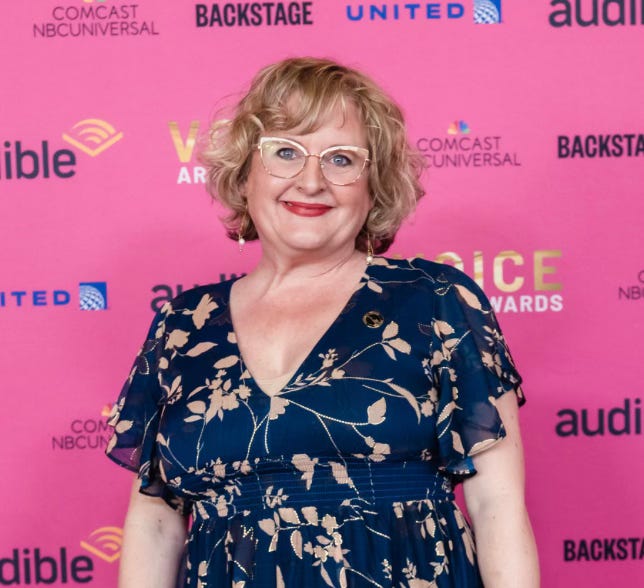
Tanya Eby writes and narrates. She lives in Michigan. She thinks all stories, regardless of genre, are worthy and wonderful. She wrote a nonfiction book, a memoir, called THE TUESDAY GIRL. To listen to her work of biographies and memoir, check out her titles on Audible: HERE.
Like this post? Please share it.
Thank you for this. It's timely as I have a biography to do for a Big 5 in a couple of weeks. My first directed session!! After reading this article, I now feel more confident as your suggestions align with how I planned to read it. Thanks again!
Thank you for this, Tanya! I too am diving into a memoir which also has self help elements and appreciate your take that mindfully creating characters as they support and follow the text is an option in nonfiction. I’d heard the hard and fast rule of no character voices in nonfiction but this story calls out for some differentiation. Much appreciated!